
Delegate rained curses on corrupt Nigerians
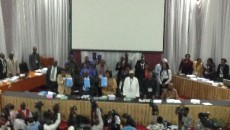
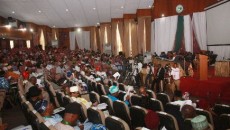
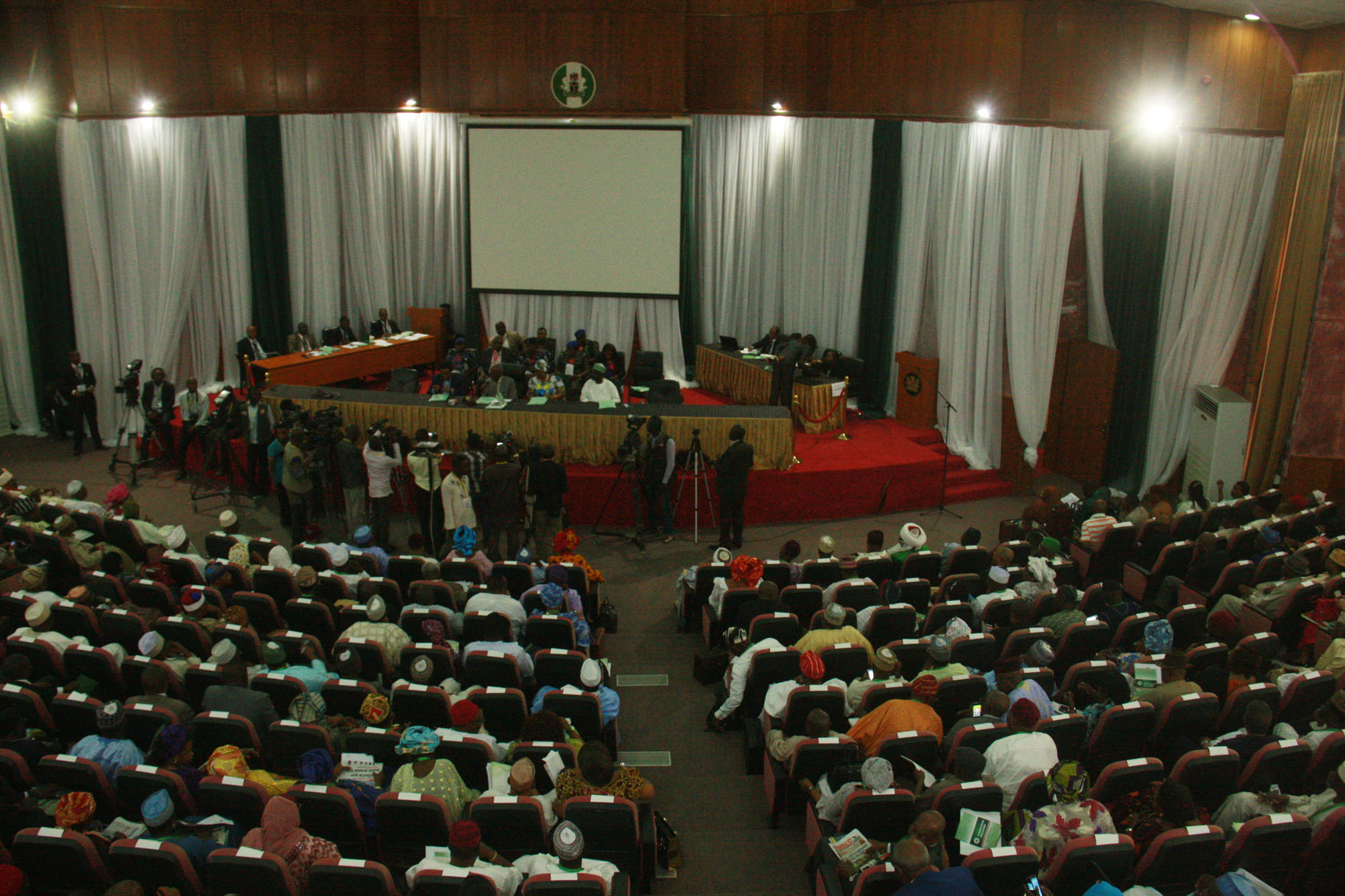
The delegates to the National Conference, on Thursday concluded debate on President Goodluck Jonathan’s inaugural address to the Conference.
The president delivered a 28-page speech while inaugurating the 492-member conference on March 17 at the National Judicial Institute, NJI, Abuja.
In the address, Mr. Jonathan said “This Conference is open for us to table our thoughts and positions on issues, and make recommendations that will advance our togetherness.”
He also denied having a personal agenda for convoking the Conference.
The delegates commenced discussion on the speech on March 24, a week after the inauguration.
During the debate, each delegate was given three minutes to comment of Mr. Jonathan’s address though many of them could not keep to the time as they overshot it.
Many of the conferees advocated for true and fiscal federalism, devolution of powers, resource control, structure of government, increasing standard of education, unity of the country, women rights and ways and means of strengthening the country’s democracy.
Other issues raised were insecurity and increasing cases of corruption in the country.
The Deputy Chairman of the Conference, Bolaji Akinyemi, who moderated the afternoon session, asked delegates to send their interventions to the secretariat if there were areas that were not properly captured while discussing the president’s address.
He said the secretariat would compile the contributions of each delegate and distribute same to all the delegates at a subsequent session.
However, an elder statesman from Ogun State, Ayo Adebanjo, opposed the directive, saying that some delegates might be tempted to include things they did not say on the floor, which had already been captured by the Hansard.
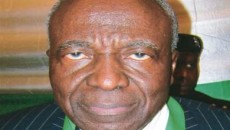
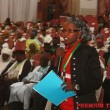
Meanwhile, during the debate on the president’s address on Thursday, a delegate of the Borno State Government, Haruna Yerima, rained curses on Nigerians who stole public funds.
Mr. Yerima, a former member of the House of Representatives, openly prayed that God should touch the hearts of corrupt Nigerians to return the looted monies, failing which He should destroy them.
He added, “All those who stole our money and built mansions let thunder, fire and earthquake destroy those houses. As for those who stole our money and took it abroad let God touch their heart xo that they can bring back this money to improve our people’s livelihood.
Mr. Yerima said a former governor of Borno State who he did not name destroyed education in the state, but that the same person had four private aircraft, including one he recently bought at N11 billion.
According to the delegate, the former governor once claimed that he did not care about what the media would write about his administration because over 50 per cent of the people of the state could not read. He also blamed the Federal Government for ignoring the state completely.
He advised Mr. Jonathan not to be carried away by what was being said about him at the Conference though he (the president) had claimed he was the most criticised president in Nigeria’s history.
Another delegate, Tanko Yakassai, dismissed the claim that southern part of the country was more populous than the north.
Mr. Yakassai, an indigene of Kano, who was nominated into the Conference in the category of elder statesmen, said before the 1914 amalgamation of the northern and southern protectorates, the first population census held in 1911 showed that the northern protectorate outnumbered the south and Lagos.
He said the estimate as it was, gave a total population of the two protectorates and the colony of Lagos at 16,054,000 and that of the northern protectorate at 8,120,000 representing 51 per cent. The East, according to him had 4,500,000 (28 per cent) while the west and Lagos had 3,360,000 (20.9 per cent) and 74,000 (0.5 per cent) respectively. This, he said, means the entire south had 49 per cent.
He also stated that the 1921 census, which was the first conducted after the amalgamation, recorded the population of the country at 18,720,000 out of which the north had 10,560,000, representing 56.4 per cent and the south had 43 per cent. He gave the breakdown to include East 5,110,000 (27.3 per cent), West 2,950,000 (15.8 per cent) and Lagos 100,000 (0.5 per cent).
Mr. Yakassai said the 1931 Census put the country’s population at 20,056,000 out of which the north had 11,440,000 (57 per cent), East 4,550,000 (22.7 per cent), while that of the West was 3,940,000( 19 per cent) and Lagos 126,000 (0.7 per cent).
He also told the Conference that the 1951/1953 census figure recorded the population of Nigeria at 30,402,000 out of which the north had 16,835,000 (55.4 per cent), the East 7,215,000 (23.7 per cent), the West 6,085,000 (20.1 per cent) and Lagos had 267,000 (0.8 per cent).
He said that though the issue ought to have been scientifically put to rest by virtue of the results of various head counts with active participation of the United Nations experts on demography and statistics, the controversy had abated.
“This controversy has consistently featured in our national discourse and is inimical to pursuit of unity and peaceful coexistence amongst Nigerians,” he said.
According to him, the sad reason for the continuation of the argument or controversy appeared to be the fact that since population was a factor for political representation and resource allocation, among other things, some individuals constantly sought to discredit scientifically established population figures with ‘sweeping and sometimes illogical arguments’, in a bid to justify the call for less revenue allocation and political representation to certain parts of the country.
Mr. Yakassai criticised calls by some delegates, notably those from the south, for resource control.
According to him, studies have shown that that between 1914 and soon after Independence in 1960, the north generated and contributed more revenue than the south.
He said the north had always bankrolled every year of the first 40 years of Nigeria’s existence, stressing “Therefore to call the North a parasite is the height of ingratitude and in the circumstance, worse than mere case of blaming a victim.”
He said that the spirit of sacrifice and practice of brother’s keeper were mere virtues that characterised the selfless and generous distribution of funds amongst the North and the south in the period.
Auwalu Yadudu, a delegate of the North West geo-political zone, said though Mr. Jonathan said he had no personal agenda while inaugurating the Conference, there appeared to be a bold agenda by acts of commission or omission.
The former Legal Adviser to the late Head of State, Sani Abacha, said it was a fact that the Conference was not designed in conformity with popular or democratic indices, contrary to the advice offered by the Okunrounmu Committee.
According to him, “the composition of the Conference was based on template of criteria that fly in the face of democratic norms that are universal.”
The delegate said the Conference lacked the essential brief or mandate to restructure Nigeria with finality, adding that it was merely a dignified presidential advisory committee.
“I admit that many in this august gathering may not offer their varied and rich experience and expertise if they had to submit to the electoral process. Yet, we should not engage in self-delusion.
“Given our skewed and undemocratic composition, we cannot claim to remove the lie (we, the people) that has too frequently been pointed out to adorn the preamble to our constitution.
“Being unelected, this Conference lacks the essential brief or mandate to restructure Nigeria with finality. I join all those who have urged us to accept our limited function as just another dignified presidential advisory committee, albeit enlarged.”
On the argument that the National Assembly lacked sufficient popular mandate or credibility and therefore incapable of reconstructing Nigeria, Mr. Yadudu reminded the Conference that Mr. Jonathan was also a beneficiary of the same deeply flawed electoral process as the lawmakers.
“As such, he (the president) cannot claim or be ascribed any more legitimacy than the National Assembly. Yet we recognize his constitutional powers to convene and have responded to his call to participate in the Conference.
Mr. Yadudu suggested that in order to ensure that the outcome of the conference did not suffer the same fate as similar exercises in the past, the Conference should do the following:
-draw up a very clear road map that spells out the necessary legal and institutional frameworks to guide the implementation of its resolution;
-A dedicated Committee of the Conference should be established to attend to this from the onset;
-All Conference resolutions requiring legal and constitutional expressions must be carried out in accordance with the 1999 Constitution and extant statutory provisions;
-Conference must propose draft legislations for enactment and implementation by the National Assembly; and
-Policy proposals and options should go to the executive arm.