





Ten-year-old Abubakar Gaddafi moved through the Sokoto central market with a bucket full of sachet water, unperturbed by the noise of vehicular movement. It was noon on a Tuesday in early June, when most other children were in schools around the metropolis.

Abubakar told this reporter that he stayed out of school some days of the week to earn a living.

|

|
“My mother buys the sachet water for me to sell, and she uses the money to buy what we eat,” the Primary Four pupil of Gwaza Primary School said.
He explained that he makes about N1,500 from selling three full buckets.
|
|
|
|---|

Abubakar could not see the point of Western education. He said his dream is to become a “mallam” (an Islamic teacher) and to support his mother.
Thousands of kids like Abubakar are on the streets of Sokoto begging, hawking or doing menial jobs to survive. They form a large part of the high number of out-of-school children in the north-western Nigerian state.


According to a 2023/24 report by the National Senior Secondary Education Commission (NSSEC), Northern Nigeria recorded over 63 per cent of the 127,067 children dropping out of school nationwide. This means the region had 80,052 dropouts.

Stay Ahead with Premium Times
Follow us on Google News and never miss breaking stories, investigations, and in-depth reporting.
 Add as a preferred source on Google
Sokoto had 11,339 school dropouts, predominantly male students. Economic pressures, such as Abubakar’s case, cultural norms, and prioritising informal apprenticeship and menial jobs over basic education, were identified as causative factors.
‘Hawk or Go Hungry’—The Story of Sokoto Almajiris
Abubakar Gidandare, 17, sat in a filling station close to the market, his head nestling on his lap. He had moved about the metropolis with his ‘Kunu’ drink but recorded poor sales.
“The drinks are not cold again. That is why you see people dropping it. I have been out since 10 a.m. and have only sold half of the drinks,” he said. “I will take the remaining ones back home because I round up my sales at 1 p.m. This is what I do every day. I don’t go to school.”

The teenager attends an Almajiri school in Sokoto for Islamic knowledge. Like most schoolmates, he can neither read nor write his name. During the day, he hawks for the wife of his mallam in exchange for food. He said he is denied food whenever he skips his daily hawking routine.
His plight reflects the struggle of over 10 million children under the Almajiri system in northern Nigeria, the majority of whom lack access to basic welfare. Despite increased primary school enrolment, there are about 113,208 Almajiri children in Sokoto, mostly boys living outside of family care.
Despite free basic education in Sokoto public schools, 15-year-old Zul-Kifilu Muhammed told this reporter that school enrollment is too expensive.
Zul-Kifilu sells sachet water during school hours. “I make about N2,000 daily and feed myself,” he said.

Tukur Abubakar, an Islamic teacher in Sokoto, said having too many children in his Almajiri centre makes it impossible to feed them. He said parents were told to provide for their children, but many do not.
“If you bring a child to me, you have to take care of his welfare. Our part in their life is to give them the “all-Ilimin addini” (religious knowledge) they deserve,” he said.
Mr Abubakar appealed to the government and other groups for support because “I want the children to at least understand how to count numbers in English.”
Driven By Despair
Aisha, Fatimah and their brothers found their way to Sokoto after bandits sacked their village in Katsina. According to them, the bandits set the village on fire and kidnapped some villagers. Those who survived the attack returned to rescue the spared children.
“Everybody was told to find their way out of the village. Somebody helped us and paid for our transport. That’s how we ended up here,” they told this reporter in Sokoto.

Left with no parents, the children beg for alms on the streets, exposed to physical danger and health hazards.

Impact of children’s exposure
Abdulrazaq Taiwo, the dean of the Faculty of Dental Science at Usmanu Danfodiyo University Teaching Hospital (UDUTH), Sokoto, decried the Almajiri children’s exposure to harsh climate and other risks.
“The weather is very hot, and when you spend too much time in it, you will lose a lot of water. You can be dehydrated, you can have a stroke, and you can die from it,” he said.
He said the children also face risks of food-borne diseases, typhoid, diarrhoea, and similar diseases due to the kind of food and water they consume.
“They take food from anybody; they don’t know how it was processed. They collect several foods on the same plate without bothering to wash the plates.”

One of the impacts of inadequate healthy food for children is stunting.
According to the World Health Organisation (WHO), stunting occurs when a child has not received proper and adequate nutrition over an extended period. The problem has been linked to poverty.
UNICEF data show that Nigeria accounts for one of the highest burdens of stunted children in the world, with a national prevalence rate of 34.2 per cent of children under five.
The global organisation further noted that two million children in the country battle with severe acute malnutrition, resulting from insufficient energy, protein and other nutrients to cover individual needs. In Sokoto State alone, approximately 900,000 people are acutely food insecure, a figure expected to increase to 1.2 million during the lean season.
Neglecting School, hustling on the streets
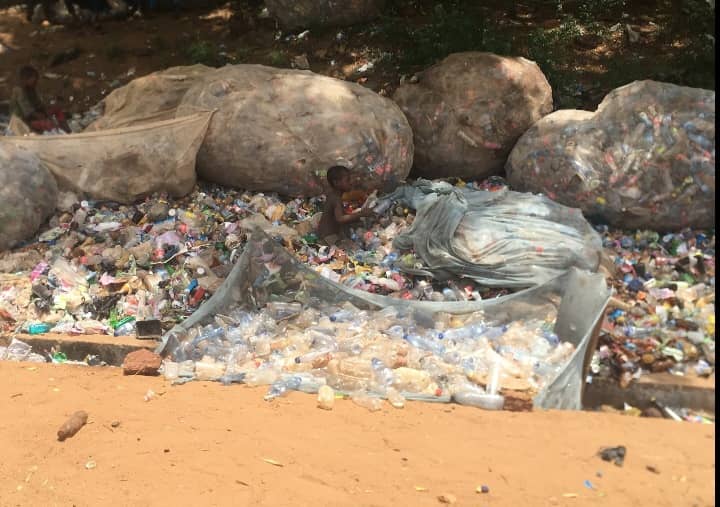
In Dendima, an outskirt of Sokoto, school-age children work during school hours at a recycling field under the shade of giant trees.
When Ibrahim Abdul, 15, arrived at the site two years ago, he said he resumed work after school. But he no longer attends school and now works from morning until evening.
The children revealed that they make N2,000 daily from the “field work”, a claim this reporter confirmed from their “manager” on the site.

“There’s possible involvement in petty crimes, prostitution and drug abuse. Those children going out for menial jobs sometimes ended up in drugs and thuggery,” said Shehu Tsagem, a professor of Education at Usmanu Danfodiyo University, Sokoto.
A 2025 research revealed that in Sokoto, many children abandon their studies for labour to support their families, perpetuating the cycle of poverty and limiting opportunities for upward mobility.
Mr Tsagem, who teaches Guidance and Counselling, identified exclusion from political, economic, and social activities as another challenge facing out-of-school children. He blamed the governments for not giving the problem the necessary attention.
“There should be a massive awareness campaign on the importance of formal education from the grassroots through traditional rulers, religious leaders and people whom they trust.”
A recent report by HumAngle showed how terrorists in North-Central Nigeria exploit hunger to recruit vulnerable children into their camps.

According to UNICEF, more than 8,000 children were trapped in the insurgents’ recruitment. The insurgents, since 2009, have used child soldiers for their activities.
Similarly, drug abuse has been categorised as one of the direct implications of dropouts among adolescent children in Sokoto, paving the way for other vices such as violence, destruction of public properties, broken homes, sexual abuses, commission of crimes, and theft.
Legal Implication
In 2021, the Sokoto State Government passed the Sokoto State Child Protection Law. The law provides for the right to free, compulsory, and universal education for every child. This includes the right to parental care, protection, and maintenance and protection against child labour, especially when it will interfere with the education of such a child.
For instance, Section 23 protects children under the age of 18 years from exposure to child labour while specifying punishment for any person found guilty of contravening the section. The law also mandated the government to implement the law.
Section 15 subsection 1 reads: “Every child has the right to free, compulsory, and universal basic education and shall be the duty of the Government in the state to provide such education.”
Yet, children of school age interviewed by this reporter and several others roaming the streets are barely protected, as parents and the government violate the law with impunity.
Ahmed Musa, a Kano-based legal practitioner, argued that the poor implementation of the Sokoto law stems from systemic, cultural, and institutional challenges.
Insufficient public awareness means perpetrators and victims often do not recognise when rights are being violated, he said, explaining that a lack of standardised enforcement units or a task force dedicated to child protection usually results in poor prosecutions or low conviction rates.
“Outdated penalty structures don’t deter offenders effectively, as fines or custodial sentences are not proportionate in preventing further occurrence,” he said.
The human rights advocate suggested that youth mobilisation is one method of curbing the issue. He emphasised that young people should be empowered with resources to serve as community watchdogs while reporting violations and referring cases to authorities.
“Form statutory Child Rights Committees at the state and local levels. This should comprise government representatives, civil society organisations, women lawyers, media, and security officers, with clear terms of reference. Ensure the committees meet quarterly to review cases, track referrals, and publish progress reports.”
This reporter tried to reach officials of the Sokoto State Government but could not. Between June and July, the reporter visited the state Ministry of Justice and was asked to submit a letter seeking an interview with state government officials.
However, despite the letter, multiple visits to the ministry and telephone reminders, the officials failed to respond to the enquiries or schedule an interview session as promised.
This reporting was completed with the support of the Centre for Journalism Innovation and Development (CJID)
Discover more from Premium Times Nigeria
Subscribe to get the latest posts sent to your email.

More News


