





The Presidency reacted on Sunday to the allegation of financial recklessness and economic mismanagement levelled against the administration of President Bola Tinubu by former Vice President Atiku Abubakar.

Atiku, the presidential candidate of the African Democratic Congress (ADC), had, in a statement by his media aide, Phrank Shaibu, accused the administration of excessive borrowing in the 2024 budget, questioned the removal of the fuel subsidy, criticised the tax reforms, concocted an oil windfall and claimed that Nigeria was drifting economically.

|

|
He said the administration’s attempt to rewrite the country’s economic realities through creative accounting and polished public presentations, while maintaining the hardship Nigerians face, tells a different story entirely.
The former vice president noted that the comments by the Minister of Finance, Taiwo Oyedele, regarding savings from the removal of the fuel subsidy are inconsistent with the available financial records.
|
|
|
|---|
He stated that the Tinubu administration is increasing the nation’s indebtedness to the CBN rather than reducing it.
According to the statement, the government’s borrowing from the bank increased by ₦17.39 trillion between May 2025 and May 2026, representing a 77.6 per cent rise.


“This destroys the narrative that subsidy savings are being used to reduce government indebtedness. Nigerians deserve honesty, not creative accounting,” Atiku said.

Stay Ahead with Premium Times
Follow us on Google News and never miss breaking stories, investigations, and in-depth reporting.
 Add as a preferred source on Google
But in a statement, the Special Adviser on Information and Strategy to the President, Bayo Onanuga, said Atiku’s claims were based on outdated data that do not take into account the significant macroeconomic gains recorded in 2025 and 2026.
“Politics thrives on disagreement. Democracy demands it. But disagreements must be rooted in facts, not frozen snapshots of history. When yesterday’s data are presented as today’s reality, the public deserves context.
“Former Vice President Atiku Abubakar, in his typical pastime, has accused the administration of President Bola Ahmed Tinubu of fiscal recklessness, citing excess borrowing in the 2024 budget, questioning the removal of fuel subsidy, criticising tax reforms, concocting an oil windfall of ₦7.98 trillion, and suggesting that Nigeria is drifting economically,” Mr Onanuga said.
FACTS, NOT FEAR: A POINT-BY-POINT RESPONSE TO ATIKU ABUBAKAR ON NIGERIA’S REFORM JOURNEY
Politics thrives on disagreement. Democracy demands it. But disagreements must be rooted in facts, not frozen snapshots of history. When yesterday’s data are presented as today’s reality, the public deserves context.
Former Vice President Atiku Abubakar, in his typical pastime, has accused the administration of President Bola Ahmed Tinubu of fiscal recklessness, citing excess borrowing in the 2024 budget, questioning the removal of fuel subsidy, criticising tax reforms, concocting an oil windfall of ₦7.98 trillion, and suggesting that Nigeria is drifting economically.
His concerns, though misplaced, deserve a response—not because criticisms should be silenced – but because Nigerians should have a fuller picture of where the country is today. Here are the real issues Atiku and his courtiers should apprise themselves of:
Debate anchored in 2024 Cannot explain Nigeria in 2026
Perhaps the first observation is chronological. It is curious that, in the middle of 2026, the opposition’s principal economic argument remains anchored in developments from the 2024 fiscal year. Economies are dynamic. Reforms are processes, not events. Judging a reform programme solely by its earliest and most painful phase is like judging chemotherapy by the nausea it induces while ignoring the remission it seeks to achieve.
The Nigerian economy, which underwent painful adjustment in 2024, has evolved considerably. Following the exchange-rate reset, Nigeria’s dollar-denominated GDP fell to about $253 billion, reflecting the immediate effect of currency realignment. Since then, figures from statistical bodies and multilateral agencies such as the IMF indicate that it has recovered significantly to approximately $377 billion, representing an increase of roughly 49 per cent from that post-adjustment trough. Likewise, Nigeria’s GDP has expanded from about ₦314 trillion in 2024 to around ₦530 trillion, a 69 per cent increase reflecting both higher economic activity and price changes. These figures should continue to be assessed alongside real GDP growth, inflation, and household welfare. They do illustrate that the economy did not remain frozen at its most difficult moment.
The reforms were never advertised as painless. They were presented as necessary structural adjustments intended to correct long-standing distortions, including distortions created in the Obasanjo-Atiku years, 1999-2007.
Borrowing must be judged alongside economic capacity
On the matter of Nigeria’s debts, it is important to ask a broader question: What is Nigeria’s capacity to sustain its debt? Debt, in itself, is not the defining measure of fiscal health. What matters are the size of the economy, our revenue-generating capacity, debt servicing costs, the purposes for which funds are borrowed, and whether borrowed resources finance productive investments or recurrent consumption. Nigeria’s debts have been acquired for productive, long-term infrastructural and investment purposes – according to the law.
Nigeria’s debt-to-GDP ratio remains relatively modest (at barely 40 per cent) compared with many peer economies and advanced countries (South Africa (85 per cent), Egypt (80 per cent), Ghana (60per cent), Kenya (75 per cent), USA (130 per cent), UK (110 per cent), China (300 per cent – unofficially), even though debt-service pressures have historically been significant. Still, the Tinubu Administration has seen a reduction in the debt service-to-revenue ratio, from nearly 100 per cent in December 2022 to less than 60 per cent today. This is a remarkable achievement that shows that Nigeria’s revenue efficiency has improved, while debt management remains conservative and astute. All the same, the more meaningful question is whether borrowing finances investments that expand productive capacity and future revenues, rather than merely postponing difficult choices.
Where did subsidy savings go?
For decades, economists across ideological divides criticised Nigeria’s fuel subsidy as fiscally costly and poorly targeted. Even before the current administration, several international institutions had argued that the subsidy consumed resources that could otherwise support development. Nigerians have suffered over the years as a large proportion of our resources has been diverted to pay fuel subsidy to merchants. An idea mooted in the early 1970s, when Nigeria saw its first oil boom in the aftermath of the Yom Kippur War, had become toxic and a drain on the economy. It must be said that the government in which Alhaji Atiku was Vice President waded through that toxic phenomenon, and never did the needful. The current administration deserves commendation for getting rid of something that has become a lodestone around the neck of our collective patrimony.
The visible consequence of subsidy removal has been the sharp improvement in revenues accruing to states and local governments through the Federation Account. Higher statutory allocations have expanded fiscal space at the subnational level, enabling many states to increase spending on roads, schools, hospitals, salaries, pensions, and social programmes. Independent assessments, including those from the World Bank, have noted improvements in public revenues and subnational capital spending, which is another word for infrastructural development, following major fiscal reforms. This means that President Tinubu has tactically placed more responsibility for socioeconomic development on states and local governments while providing the requisite funding. This is true federalism and a bold statement on the much-vaunted subject of economic restructuring – another important issue gallantly avoided by the government in which Alhaji Atiku served and wielded great influence.
Tax Reforms: Progressive, not punitive
Another of Atiku’s uninformed criticisms suggests that the Tinubu administration chose to tax Nigerians more. This is blatantly false, and the statement is an attempt to deceive and dissemble.
The objective of the tax reforms is not merely to increase collections but to create a broader, more equitable tax system. The reforms are intended to reduce the burden on many low-income earners (people earning N1 million per annum and below) and small businesses (with turnover of N100 million and below) while strengthening compliance among higher-income individuals and profitable enterprises – many of whom had avoided or evaded taxes under the cover of informality for decades. The underlying principle is that those with greater capacity should bear a larger share of the tax burden, while micro-enterprises and vulnerable households receive greater protection. Nigerians understand that to have a fine, working nation, we all must contribute to its prosperity. And we are on course.
Health: From Infrastructure to Access
Over the past three years, the Federal Government, working with states, has expanded efforts to rehabilitate and upgrade primary health care facilities, strengthen tertiary hospitals, improve access to essential medicines, and broaden maternal and child health interventions.
The administration has also publicised initiatives aimed at reducing the financial barriers to maternal care, including programmes that support access to caesarean sections for eligible indigent mothers through public facilities. Over 100 four-year programme facilities across Nigeria provide free caesarean operations for indigent mothers. Thousands of women ac ross the country, from Sokoto to Port Harcourt, have benefited. Three world-class cancer centres are operational in Kubwa, Enugu, and Katsina, while cancer centres in 13 states have been expanded. As of April 2026, over 3,000 Primary Healthcare Centres have been revitalised, upgraded, and refurbished, while over 78,000 frontline workers have been retrained in 3 years. This is verifiable information, and no mean feat.
Education: Investing in human capital
Federal and state governments have undertaken school rehabilitation, investments in technical and vocational education, digital learning initiatives, and expanded access to tertiary education finance in the last 3 years. Specifically, over 11,000 projects have been undertaken by the Universal Basic Education Commission, in collaboration with the federal and state governments. This can be regarded as one of the boldest moves in Nigeria’s history to reposition education at the primary and secondary levels.
Among the flagship initiatives is the Nigerian Education Loan Fund (NELFUND), which has enabled hundreds of thousands of students to access loans for tuition and upkeep, reducing financial barriers to higher education. Over 1.64 million students have benefited nationwide, with NELFUND disbursing over ₦303 billion to 300 higher institutions. Again, another unprecedented initiative that positively touches lives. All over social media, Nigerians can see how relieved and jubilant Nigerian students have become. Add to this the fact that President Tinubu has seen to an end to strikes by university lecturers, such that a debt service-to-revenue ratio of a four-year programme does not go beyond four years, a great relief to students and parents.
Infrastructure: Building for tomorrow
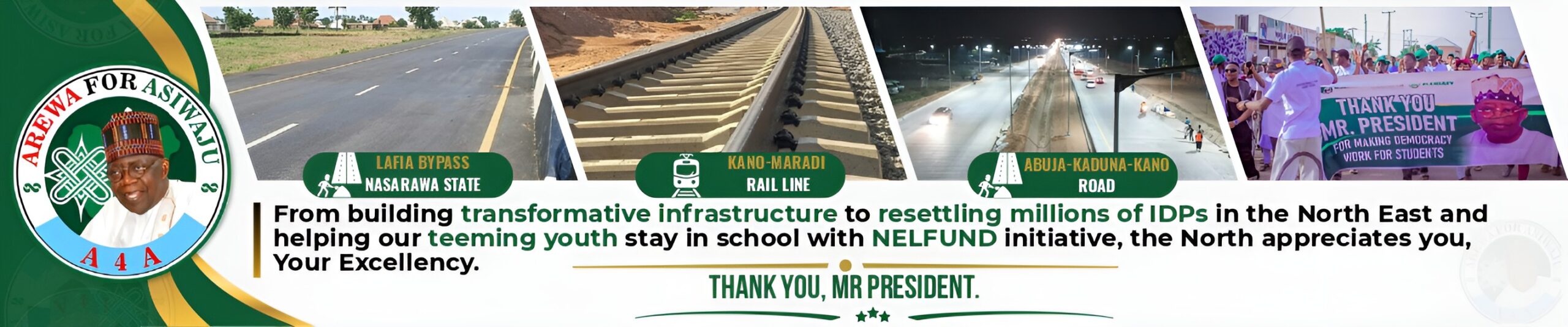
Nigeria’s infrastructure agenda continues across transport, energy, and public works, with ongoing projects in federal highways and bridges, rail modernisation, inland dry ports and logistics, power transmission and distribution, airport redevelopment, gas infrastructure, housing, and digital connectivity. Many state governments have simultaneously accelerated road construction, urban renewal, healthcare, and education projects, aided by stronger fiscal inflows. The cumulative effect is an increase in public investment aimed at reducing logistics costs and supportingrting private-sector growth, the triggers for the 49% leap in GDP since 2024 (in revenueDollar terms), and a 69% leap in Naira terms. There is a lot more to come.
Nigeria is certainly not over-borrowed
The unvarnished truth is that Nigeria’s revenue-to-GDP ratio, is still ranked among the, lowest globally, limiting the government’s ability to fund public services without borrowing.
Recent reforms have started to improve revenue mobilisation, broaden the tax base, reduce leakages, and strengthen public financial management. Certainly, improvements in revenue collection are helping reduce fiscal vulnerabilities. But this is a process that has commenced. Viewed from this angle, it is evident that President Tinubu has taken the Nigerian economy down a path of unprecedented reinvention and rejuvenation.
ALSO READ: 2027: ADC uploads Atiku, Amaechi’s nomination particulars to INEC portal
The debt debate should, therefore, examine not only how much Nigeria borrows but also whether the addressing the country’s capacity to generate and manage revenue continues to improve. At a mere 40 per cent debt-to-GDP ratio and less than 60 per cent debt service-to-revenue ratio (improving), the argument of overborrowing is alarmist and does not stick.
Oil windfall? Atiku and his handlers reveal analytical deficiency
There is no such windfall of ₦7.98 trillion. Any incremental revenue from higher oil prices is reflected in the monthly FAAC figures. While the average price for the half-year 2026 for Brent is around $90 compared to the $64.85 benchmark, the average daily production fell short at about 1.6m bpd compared to the forecast of 1.84m bpd. The production shortfall partly offset the price premium. In addition, some crude volume had been pledged for loans used to pay for the wasteful subsidy in the past, which the President was bold enough to remove, stopping the bleeding but not immediately translating into available revenue.
The convenient mistake many analysts make is to multiply the oil price by the daily crude production volume to determine revenue to the government. Such analyses ignore the cost of production, the share of crude belonging to the oil-producing companies and the impact of crude sale contracts such as forward contracts designed to hedge against price volatility.
Atiku will do well to show the workings for his ₦7.98 trillion oil windfall.
Conclusion: For Nigeria, forward ever!
History rarely remembers governments for the popularity of their decisions in the moment. It remembers whether those decisions ultimately strengthened or weakened the nation.
President Tinubu’s administration has chosen to dismantle several long-standing policy distortions that previous governments acknowledged but often deferred. The reforms have carried undeniable costs, and legitimate questions remain about implementation, inflation, and social protection. Yet describing the entire programme as “financial recklessness” overlooks the broader context of structural change, fiscal rebalancing, and efforts to improve macroeconomic stability.
A mature national conversation should move beyond slogans. It should assess reforms against measurable outcomes rather than isolated episodes. We welcome elevated discourses that examine the philosophical underpinnings of President Tinubu’s approach to the economy, not pedestrianism. Nigerians need elevated standards of living, which requires immediate sacrifices. But indeed, the worst is over, as the effects of the necessary economic chemotherapy were more severe in 2023 and 2024. All economic watchers are aware that in November 2025, inflation rates in Nigeria fell to 14.4 per cent. Because of the disruption caused by the Middle East War, the rate shot up to 15.91 per cent. But it has begun another descent as economic analysts project that inflation will trend towards 12 per cent by the end of the year.
As part of measures to bring relief to Nigerians severely impacted by the economic reforms, the Federal Government recently launched the ward-centric NG-CARES, HOPE, and SOLID programmes worth more than $3 billion to strengthen primary healthcare, basic education, and support for vulnerable communities. This is in addition to the Humanitarian Ministry’s cash transfers to 15 million vulnerable households, helping to lift them out of extreme poverty.
Nigeria’s economy is not yet where it aspires to be. But neither is it where it stood at the height of its structural distortions or in the bygone years of fiscal waste and slackness. The fundamental reforms will continue to expand opportunity, strengthen institutions, and deliver tangible improvements in the lives of Nigerians. That is the focus of President Tinubu. All else is an attempt by political carpetbaggers to gain attention.
Bayo Onanuga
Special Adviser to the President
(Information & Strategy)
August 2, 2026
Discover more from Premium Times Nigeria
Subscribe to get the latest posts sent to your email.

More News


